
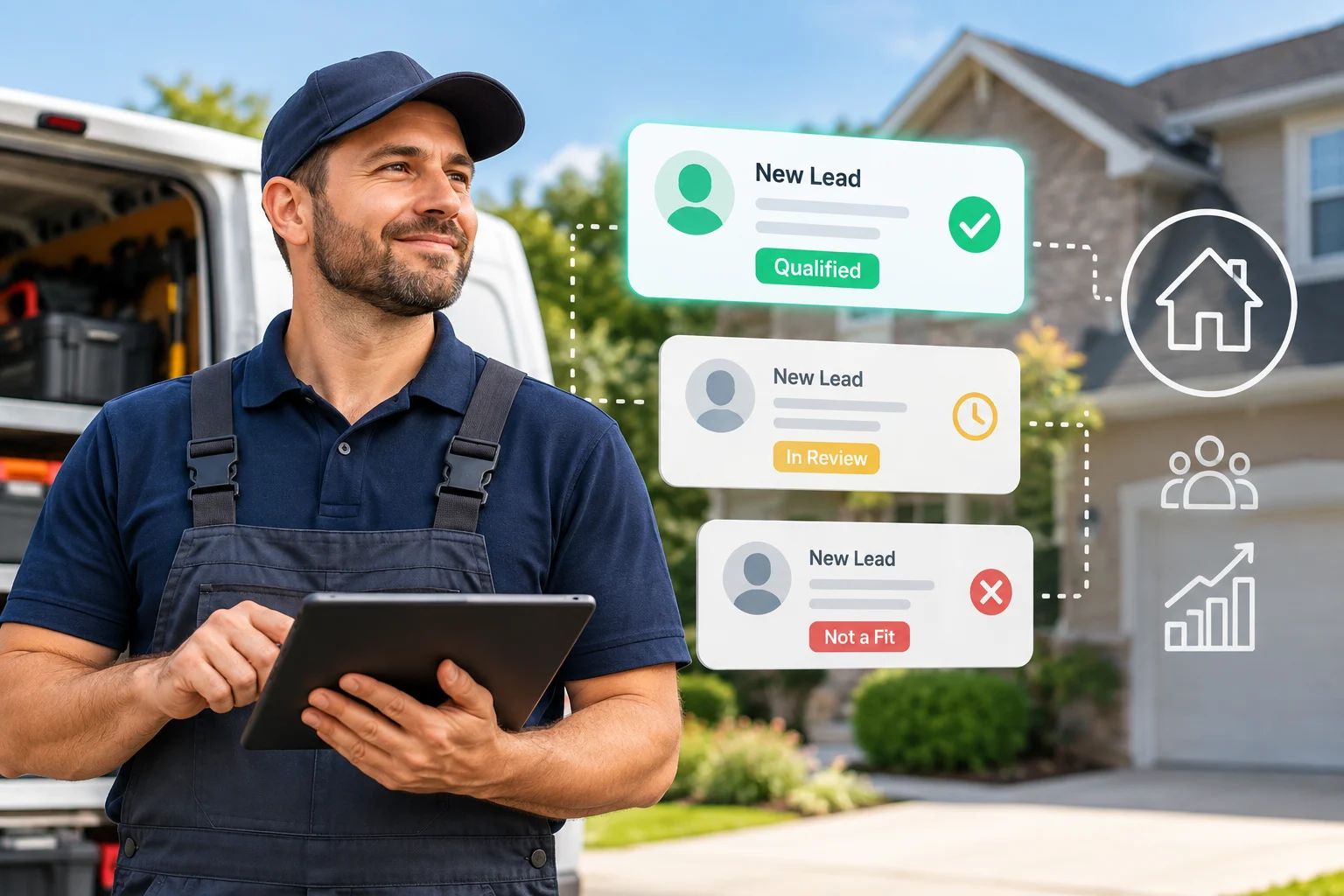
A steady stream of inquiries can look encouraging on paper, but local home service businesses ultimately need more than volume. A full inbox does little for a contractor if most inquiries come from outside the service area, involve work the company does not perform, or never progress beyond an initial question.
Lead quality is about attracting people who have a realistic need for the service, are located within the areas the business serves, and have enough intent to take the next step. Improving that quality usually requires several parts of the customer acquisition process to work together, from messaging and targeting to qualification and follow-up.
Define What a Good Lead Actually Looks Like
A business cannot improve lead quality until it knows what a useful lead looks like.
The definition will vary considerably between home service companies. A roofing contractor may prefer homeowners requesting inspections or replacement estimates, while an HVAC company might prioritize repair, maintenance, or installation inquiries within a particular service radius.
Useful characteristics to consider include the service requested, geographic location, urgency, property type, approximate project scope, and whether the person contacting the business is in a position to make a decision.
This does not mean every prospect must be ready to book immediately. Some worthwhile customers will still be researching their options. The objective is to distinguish genuine potential customers from inquiries that have little chance of becoming appropriate jobs.
Companies reviewing different customer acquisition approaches can use providers such as Home Pro Leads as one reference point while defining the types of inquiries that make sense for their own operations.
Focus on Relevance Instead of Raw Volume
More leads can create the impression that marketing is improving, but quantity alone can be misleading.
Imagine one campaign produces 60 inquiries, but only a small portion fall within the company’s service area. Another generates 25 inquiries, most of which are for services the company regularly provides.
The second campaign could be far more useful despite delivering fewer names and phone numbers.
That is why businesses should track what happens after a lead arrives. Useful indicators include how many inquiries are qualified, how many result in appointments, how many estimates are provided, and how many eventually become booked jobs.
Looking further down the customer journey makes it easier to distinguish sources that simply generate activity from those that consistently produce relevant opportunities.
Make Your Service Offering Specific
Unclear messaging often attracts unclear inquiries.
If a website describes a company simply as providing “complete home improvement solutions,” visitors may have difficulty understanding exactly which projects the business handles. That can result in calls and form submissions for services that are not actually offered.
Individual service pages can help clarify the company’s focus.
A plumber might separate drain cleaning, water heater services, leak repairs, and fixture installation rather than placing every offering on one broad page. Similarly, a remodeling company could distinguish kitchens, bathrooms, basements, and other renovation work where appropriate.
Clear service descriptions help prospective customers decide whether the company is relevant before contacting it. They can also reduce the amount of staff time spent explaining that a particular service is unavailable.
Match the Message to Customer Intent
Homeowners search for services for different reasons and at different stages.
Someone searching because their furnace has stopped working has very different priorities from someone researching whether to replace an older heating system next year.
The first person may care about availability and immediate help. The second may want information about options, expected project steps, and signs that replacement is becoming necessary.
Marketing messages should reflect these differences.
High-intent service pages should make the next step obvious. Educational content can serve customers who are still researching. Pages aimed at larger projects may need more detail than pages dealing with urgent repair work.
Salesforce’s lead generation guide discusses the distinction between prospects at different stages and the importance of identifying and developing qualified opportunities rather than treating every contact as equally ready to buy.
For local home service companies, the practical lesson is straightforward: attracting the right person at the right stage is generally more useful than attracting everyone with a broad interest in home improvement.
Tighten Geographic Targeting
Local service businesses have a natural limitation that many online companies do not: they can only work within a practical service area.
Poor geographic targeting can therefore have an immediate effect on lead quality.
A contractor should clearly communicate where the business operates on service pages, contact forms, local profiles, and advertising campaigns. If certain areas have different availability or service restrictions, that information should also be clear where appropriate.
Businesses covering several communities may benefit from dedicated location information, particularly when services or customer needs differ between areas.
However, creating dozens of nearly identical pages is not a substitute for useful local information. Each page should exist because it genuinely helps a customer understand the company’s coverage and services.
Ask Enough Questions to Qualify the Inquiry
Contact forms are often designed to be as short as possible. That can reduce friction, but collecting too little information can create extra work later.
A useful form should gather enough detail to help the business understand the request without becoming an interrogation.
Depending on the service, appropriate fields might include the customer’s location, type of service required, preferred contact method, project timeframe, and a short description of the issue.
For more complex projects, allowing customers to provide additional details can help the business determine whether the inquiry is a suitable match before scheduling a lengthy consultation.
Phone inquiries can follow a similar process. Staff should have a short set of practical questions that help identify the customer’s needs while keeping the conversation natural.
Respond While Interest Is Still High
A high-quality lead can quickly lose its value if nobody responds.
Many homeowners contact more than one provider, especially when dealing with urgent repairs or significant projects. A slow response gives the customer more time to continue speaking with other companies.
Businesses should establish clear responsibility for incoming inquiries.
Someone should know who monitors website forms, missed calls, messages, and other contact channels. If the inquiry cannot be handled immediately, a simple acknowledgment can reassure the customer that the request has been received.
Consistency is often more important than building a complicated system. A clear process for receiving, assigning, responding to, and tracking inquiries can prevent potentially valuable opportunities from being overlooked.
Review Why Leads Are Being Rejected
Poor-quality leads can provide useful information if businesses examine them rather than simply deleting them.
If many inquiries are coming from outside the service area, geographic targeting may need attention. If prospects repeatedly request a service the company does not provide, website messaging may be unclear.
If inquiries appear relevant but rarely proceed after pricing is discussed, the issue may lie elsewhere in the customer journey.
Keeping basic reasons for lost or disqualified leads can reveal recurring patterns.
Even simple categories such as outside service area, wrong service, duplicate inquiry, unreachable customer, project postponed, or customer chose another provider can make future decisions more informed.
Connect Lead Sources to Actual Revenue
One of the most useful improvements a home service company can make is connecting the original source of an inquiry to what happens later.
If possible, businesses should know which source generated the lead and whether that person became a qualified opportunity, booked appointment, estimate, and paying customer.
This makes comparisons much more meaningful.
A source with a higher cost per inquiry may still be worthwhile if it consistently generates suitable customers. A cheaper source may become expensive in practice if employees spend significant time handling irrelevant requests.
Businesses evaluating resources for home service businesses should therefore consider how any acquisition channel fits into the entire process rather than judging it only by the number of leads delivered.
Keep Improving the Process
Lead quality is rarely improved by changing one thing once.
Customer behaviour changes, service areas expand, companies add or remove offerings, and different marketing channels produce different types of prospects over time.
Regularly reviewing where leads originate, why some are disqualified, how quickly inquiries receive responses, and which sources produce booked work creates a useful feedback loop.
That information can guide changes to messaging, targeting, contact forms, service pages, and follow-up processes.
For local home service companies, the goal is not simply to keep the phone ringing. It is to create a customer acquisition system that brings in more of the inquiries the business is genuinely equipped to serve.


